Fundamental Analysis for Beginners: NFP, CPI, Interest Rates & the Calendar
Why news moves the market, which events matter most, and how to use the economic calendar so a headline never blows your account.
Technical analysis tells you where to trade. Fundamental analysis tells you why the market moves - and when it might suddenly move a lot.
What drives a currency?
Over time, currencies follow their economies and, above all, interest rates:
- Higher interest rates (or expectations of them) → money flows in → currency strengthens
- Lower rates → currency often weakens
- Strong jobs, growth and controlled inflation → central bank can keep rates higher
- Fear in markets → money runs to "safe havens": USD, JPY, CHF and gold
The big events to know
| Event | What it measures | Why it matters |
|---|---|---|
| Interest rate decisions (Fed, ECB, BoE, BoJ) | Central bank policy | The biggest driver of currencies |
| CPI (inflation) | Rising prices | High inflation → rate hikes likely |
| NFP (US jobs) | Jobs added in the US | Huge USD volatility, usually the first Friday of the month |
| GDP | Economic growth | Strength of the economy |
| Retail sales | Consumer spending | Health of the economy |
| PMIs | Business activity | Early signal of growth or slowdown |
The US dollar is in most trades, so US data moves almost everything - including gold and indices.
How to read the economic calendar
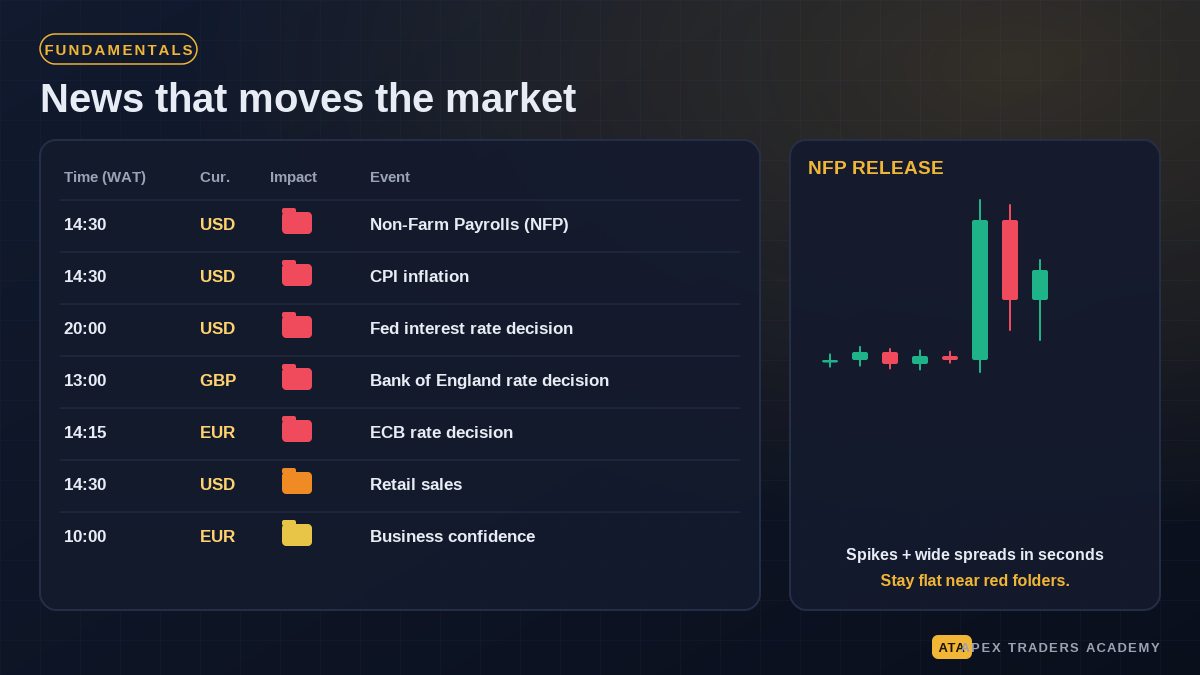
Our economic calendar (powered by ForexFactory data) shows each event with its impact:
- Red = high impact - can move the market strongly
- Orange = medium impact
- Yellow = low impact
Each event has a forecast and a previous value. Markets move on the surprise: when the actual number is very different from the forecast.
The beginner's news rules
- Check the calendar every morning (5 minutes)
- Don't open new trades in the 30 minutes before and after red-folder news on that currency
- If you're already in a trade, consider taking partial profit or moving your stop to break-even before big news
- Expect spreads to widen and slippage around releases
How fundamentals and technicals work together
At Apex we use fundamentals for context and technicals for entries. If the Fed is expected to cut rates and the weekly chart shows a dollar rejection at resistance, the two agree - extra confidence. When they disagree, size down or wait.
Every week we publish a plain-English fundamental analysis of the calendar, and the news page brings the latest headlines into one place.
Next lesson: Trading psychology: fear, greed and revenge trading
Want to see this on live charts?
Inside the course we apply every lesson to real Weekly, Daily and 4H charts - with mentorship until it clicks.
Education only, not financial advice. Trading on margin carries a high level of risk. Always use a stop loss and risk only what you can afford to lose.
Next lessonTrading Psychology: Fear, Greed, FOMO and Revenge Trading →
Your strategy can be perfect and your mind can still lose you money. Here's how to recognise the emotional cycle - and step off it.